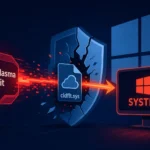
CERT/CC has published coordinated vulnerability note VU#604762, which describes a class of vulnerabilities stemming from a discrepancy between how Apple’s filesystem (APFS) resolves paths and how applications compare filenames. The essence of the problem is that APFS on macOS, by default, treats different Unicode representations of the same character (for example, ß and ss, or NFC and NFD forms of the same name) as identical, whereas a number of tools perform byte-wise path comparison. This allows a local attacker to bypass exclusion filters and overwrite protected files, inject sensitive data into build artifacts, or disrupt CI/CD pipelines. The affected products are Deno, setuptools, HashiCorp go-slug and libarchive. Patches are already available for three out of the four products.
Technical details for each CVE
CVE-2026-49401 — Deno: permissions system bypass
On macOS, the Deno permissions system used byte-wise path comparison when checking the --deny-read, --deny-write, --deny-run and --deny-ffi flags. Since APFS treats different Unicode spellings as the same file, an attacker could bypass a deny rule by specifying an alternative Unicode representation of the path. According to the Deno project advisory, the vulnerability affects versions up to and including 2.7.13 and is fixed in version 2.7.14. The issue is specific to macOS with APFS — Linux and Windows are not affected by this variant.
It is worth noting the difference in severity assessments: GitHub’s CNA advisory rates the vulnerability at 7.3 under CVSS 3.1 (High), whereas the NVD assigns 8.4 (High) with vector AV:L/AC:L/PR:L/UI:N/S:C/C:H/I:H/A:N. The discrepancy is significant and is related to differing assessments of the impact on confidentiality and integrity beyond the original security context.
CVE-2026-59890 — setuptools: bypassing MANIFEST.in exclusions
In the Python package setuptools, the exclude, global-exclude, recursive-exclude and prune directives in the MANIFEST.in file matched glob patterns against filenames on disk without taking Unicode normalization into account. On macOS with APFS or HFS+, a file whose name was in NFD form could bypass an NFC exclusion rule and end up in the source distribution (sdist). According to the setuptools project advisory, the vulnerability is rated at 6.1 under CVSS 3.1 (Moderate).
According to CERT/CC and the GitHub Advisory Database, a fix is available in version 83.0.0. At the same time, in the structured fields of the advisory in the setuptools repository, the fixed version field is set to “None” — this is a discrepancy that should be taken into account during automated dependency scanning.
CVE-2026-14978 — HashiCorp go-slug: file leakage in Terraform
The go-slug library, used by Terraform to package working directories, did not take Unicode normalization into account when processing the .terraformignore file. This made it possible to include in the uploaded slug archive files that were supposed to be excluded — potentially sensitive data (keys, configurations). According to the researcher and the Terraform release notes, a fix is available in go-slug v0.18.3. A direct security advisory from HashiCorp was not obtained as part of this analysis. We have previously written about vulnerabilities in the Terraform ecosystem.
CVE-2026-45110 — libarchive: file overwrite on extraction
An overwrite filter bypass and a directory exclusion bypass were discovered in libarchive. An attacker could add to an archive a file whose name used an alternative Unicode spelling; when extracted on macOS APFS, this file would replace the protected original. According to CERT/CC, a fix had not yet been released at the time the note was published. The range of affected versions is also not established in the available materials.
Assessment of real-world impact
CERT/CC describes the potential consequences at the level of the entire vulnerability class — data corruption, configuration tampering, code execution. However, the available researcher demonstrations are limited to narrower scenarios: bypassing exclusions when creating an archive (go-slug), including extra files in a source distribution (setuptools), and replacing a file inside an output directory (libarchive). The demonstrations did not include uploading artifacts to remote servers, privilege escalation, or writing outside the working directory. Active exploitation in real-world attacks was not observed in the sources analyzed.
Those at greatest risk are:
- Development teams using macOS to build and publish Python packages (setuptools)
- Infrastructure engineers working with Terraform on macOS (go-slug)
- Projects using Deno with deny rules on macOS to isolate code
- Any workflows on macOS where libarchive extracts untrusted archives
Mitigation recommendations
The priority of updates is determined by the availability of patches:
- Deno — update to version 2.7.14
- setuptools — update to version 83.0.0
- go-slug / Terraform — update go-slug to v0.18.3 (included in the corresponding Terraform release)
- libarchive — no patch has been released yet; you should monitor project updates and limit extraction of untrusted archives on macOS
CERT/CC’s general recommendation for developers is to implement path validation that takes into account the normalization behavior of the target filesystem, rather than relying on byte-wise string comparison. All security filters should use path formats that match the operating system’s name resolution logic.
Organizations that use macOS in their build and deployment chains should audit tools that work with file paths and exclusion filters. Three out of the four affected products already have fixes — installing them should be a priority. For libarchive, where a patch is not yet available, it is recommended to restrict processing of archives from untrusted sources on APFS systems until an update is released.