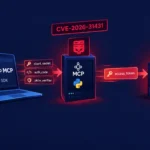
A critical vulnerability in nginx-ui, a popular open-source web interface for managing Nginx, is being actively exploited and allows attackers to gain near-total control over affected web servers. The flaw, tracked as CVE-2026-33032 and dubbed MCPwn by Pluto Security, carries a CVSS score of 9.8, underscoring its severity for any internet-exposed deployment.
What nginx-ui Does and Why CVE-2026-33032 Is So Dangerous
nginx-ui provides a browser-based control panel for Nginx, enabling administrators to restart services, create and edit configuration files, and apply changes without SSH access. This convenience also means that any failure in its authentication mechanisms immediately becomes a high-impact risk, because the interface effectively holds the “keys to the kingdom” for the web server.
CVE-2026-33032 is an authentication bypass vulnerability. In practice, this means a remote attacker can perform actions that should require admin privileges without providing any valid credentials—no passwords, tokens, or authorization headers are needed.
Technical Analysis of the MCPwn nginx-ui Vulnerability
The root cause of MCPwn lies in nginx-ui’s integration with the Model Context Protocol (MCP). To support MCP, nginx-ui exposes two HTTP endpoints: /mcp and /mcp_message. According to the maintainers, the /mcp endpoint is correctly protected by two controls: an IP allowlist and an authentication middleware, AuthRequired().
The /mcp_message endpoint, however, is protected only by the IP allowlist. Critically, the default allowlist is empty. Due to a design decision, an empty list is interpreted as “allow all IPs” instead of “deny all.” The result is that any client on the internet can reach /mcp_message without authentication, provided nginx-ui is exposed.
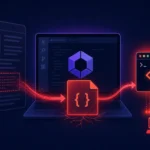
Pluto Security researcher Yotam Perkal demonstrated that only two crafted HTTP requests to /mcp_message are sufficient to fully compromise nginx-ui. Through this endpoint, an attacker can invoke MCP tools that allow them to:
- restart the Nginx service;
- create, modify, or delete Nginx configuration files;
- trigger automatic reloads of the Nginx configuration.
This effectively grants complete administrative control over the web server. An attacker can rewrite configuration to redirect traffic through their own infrastructure, insert malicious redirects, or configure transparent interception of data.
Impact on Nginx Servers: Traffic Hijacking and Credential Theft
Successful exploitation of CVE-2026-33032 does not just compromise nginx-ui itself; it enables full manipulation of all HTTP and HTTPS traffic processed by the Nginx instance. By altering reverse proxy rules or TLS termination points, an attacker can:
- proxy traffic through attacker-controlled hosts for inspection and tampering;
- inject or swap page content, including phishing forms or malware delivery scripts;
- harvest administrator and user credentials submitted through compromised sites.
Shodan scans indicate that approximately 2,689 nginx-ui instances are directly reachable from the internet, with the highest concentration in China, the United States, Indonesia, Germany, and Hong Kong. Recorded Future lists CVE-2026-33032 among 31 vulnerabilities under active exploitation in March 2026, confirming that this is an ongoing, real-world threat, not a theoretical risk.
Patch Availability and Temporary Mitigations for nginx-ui
The vulnerability has been fixed in nginx-ui version 2.3.4, released on 15 March 2026. Organizations are strongly advised to upgrade to 2.3.4 or later immediately, prioritizing any instance exposed to untrusted networks or the public internet.
Temporary Workarounds for CVE-2026-33032 (MCPwn)
Where an immediate upgrade is not possible, the following mitigation steps can meaningfully reduce risk:
- Add
middleware.AuthRequired()to the/mcp_messageendpoint so that it enforces authentication in the same way as/mcp. - Change the IP allowlist’s default behavior from an “allow-all” model to a “deny-all” stance, explicitly specifying only trusted networks.
- Restrict network access to nginx-ui with a firewall, VPN, or network segmentation, ensuring the interface is reachable only from administrator networks.
- Where feasible, temporarily disable MCP functionality until patched builds are deployed and verified.
Given the number of exposed nginx-ui instances and active exploitation, Pluto Security characterizes updating to 2.3.4 as an emergency response measure rather than routine maintenance.
Related MCP Vulnerabilities and Strategic Lessons for Developers
MCPwn is part of a broader pattern of Model Context Protocol security issues. Recently disclosed flaws in the Atlassian MCP server (mcp-atlassian), tracked as CVE-2026-27825 (CVSS 9.1) and CVE-2026-27826 (CVSS 8.2) and collectively nicknamed MCPwnfluence, can be chained to achieve unauthenticated remote code execution (RCE) on local networks.
Researchers note a recurring design mistake: when MCP is bolted onto an existing application, MCP endpoints often inherit the application’s full capabilities but not its security controls. This creates a hidden backdoor that sidesteps carefully designed authentication and authorization flows.
Organizations using nginx-ui or other MCP-enabled components should reassess their architectures with a focus on:
- minimizing exposure of administrative web interfaces to the public internet;
- enforcing strict IP allowlists and multi-factor authentication for all admin surfaces;
- conducting regular security audits and configuration reviews, including MCP endpoints;
- monitoring vendor advisories and applying security updates as part of a formal vulnerability management program.
Addressing MCPwn and similar issues requires not only patching but also a sustained effort to reduce attack surface, harden administrative interfaces, and continuously validate that new integrations like MCP are covered by existing security controls. Organizations that move quickly to upgrade nginx-ui, lock down access, and institutionalize regular security testing will be significantly better positioned against the next wave of exploitation campaigns targeting web server management tools.