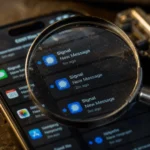
Apple has released an unscheduled security update for iOS and iPadOS to fix a critical flaw in the Notification Services subsystem. The bug, tracked as CVE-2026-28950, meant that notifications marked as deleted were in fact still stored on the device and could be recovered with forensic tools, even after the corresponding app had been removed.
Apple Issues Emergency iOS Security Update for CVE-2026-28950
In Apple’s security documentation, CVE-2026-28950 is described as a logging issue addressed through improved data redaction. In practice, the notification logging system in iOS and iPadOS failed to correctly erase or anonymize data that was supposed to be removed.
According to Apple, notifications that users or the system treated as deleted could continue to persist on the device. The flaw affects a broad range of supported iPhone and iPad models; Apple traditionally details the exact list in its security advisories, but the impact clearly spans many current iOS and iPadOS devices.
How iOS Notification Services Leaked Deleted Data
Technically, the problem stemmed from how fragments of push notification content were written into local databases or logs maintained by Notification Services. Instead of being fully cleared, those records remained accessible at the system level.
With physical access to an iPhone or iPad, specialized mobile forensic tools—the kind routinely used by law enforcement and digital forensics labs—could extract this notification database. Because it contained portions of notification payloads, including message text in some cases, investigators could reconstruct information that users believed had been deleted.
This incident highlights a recurring issue in mobile security: application-level protections are only as strong as the operating system beneath them. Even when an app correctly deletes data or uses strong encryption, OS-level logging, caching, or backup mechanisms can unintentionally leave residual traces.
FBI Case Shows How Signal Messages Were Retrieved from an iPhone
Interest in CVE-2026-28950 surged after reporting by 404 Media described a U.S. criminal case in which the FBI obtained incoming Signal messages from an iPhone despite the Signal app having been removed from the device.
Investigators relied on digital forensics tools to access the iOS push notification database. Because notifications for Signal contained snippets of message content, copies of messages were still present in system logs and could be analyzed. The end-to-end encryption employed by Signal was not broken; instead, the weakness lay in how iOS handled and stored notifications at the OS level.
This real-world example underlines a critical point for privacy-focused users, journalists, activists, and human rights defenders: compromise does not always come from “hacking the app”. It often arises from side channels such as backups, logs, and notification systems that were never designed with high-risk threat models in mind.
Why Push Notifications Are a Hidden Privacy Risk
Push notifications are commonly viewed as benign pop-ups, but from a security and privacy perspective they can expose significant information. Depending on the app’s configuration, a single notification may contain:
– full or partial message text;
– the sender’s name or identifier;
– timestamp and delivery details;
– app identifiers and notification channel metadata;
– technical fields that reveal communication patterns and frequency.
As the Electronic Frontier Foundation (EFF) and other digital rights organizations have repeatedly noted, users rarely get clear insight into which notification fields are encrypted, what is logged by the OS, and how long those logs persist. This opacity makes notification infrastructure an attractive vector for surveillance and forensic analysis, especially against high-risk groups.
Apple and Signal’s Response: What Has Changed
Apple states that CVE-2026-28950 has been fixed by enhancing data redaction in Notification Services logs. After installing the latest iOS and iPadOS updates, notifications that should be deleted are no longer retained on the device, including notifications associated with apps that have since been uninstalled.
Signal has clarified that users do not need to take any extra steps on iOS: once the patch is installed, previously and unintentionally stored notification data will be automatically removed, and new notifications for uninstalled apps will not be stored in this way.
Signal also reiterates that users can limit sensitive data in notifications. In the app’s settings (Profile → Notifications → Show), it is possible to switch to “Name only” or “No name or message.” Reducing what appears in notifications limits both what is visible on the lock screen and what may end up in internal iOS logs.
Practical iPhone and iPad Security Recommendations
The exposure caused by CVE-2026-28950 reinforces several practical steps that every iOS user should consider to strengthen mobile security and privacy:
1. Install security updates immediately.
Even seemingly minor patches can close vulnerabilities already leveraged in real investigations or targeted operations. Delaying updates extends the window of opportunity for attackers and forensic access.
2. Harden notification settings for sensitive apps.
For messengers, email clients, and any app handling confidential data, disable message previews or turn off notifications entirely. This reduces the risk of data leakage through lock screens, screenshots, and system logs.
3. Limit the impact of physical device access.
Use a long alphanumeric passcode instead of a simple 4-digit PIN, enable biometrics, shorten the auto-lock timer, configure remote wipe via “Find My iPhone,” and consider enabling automatic data erasure after multiple failed unlock attempts.
4. For high-risk users, adopt a “trace minimization” strategy.
Do not rely solely on app deletion or end-to-end encryption. Combine disappearing messages, restrictive notification settings, timely OS updates, regular reviews of installed apps, and guidance from specialist organizations such as EFF or other local digital security groups.
The story of CVE-2026-28950 shows that communication privacy is the result of an entire ecosystem working correctly—from secure app design to rigorous OS logging policies. A single weak link, such as residual notification data, can expose even encrypted conversations through indirect forensic channels. Staying ahead of these risks requires prompt installation of iOS updates, careful tuning of notification behavior, and an ongoing focus on digital hygiene, especially for those who may be subject to heightened surveillance or pressure.