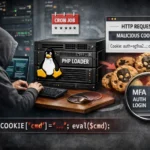
Linux web servers are facing a rise in attacks where adversaries use HTTP cookies as a covert control channel for PHP web shells. According to the Microsoft Defender Security Research Team, this method enables attackers to maintain remote access and execute commands on compromised hosts while blending almost seamlessly into normal web traffic.
How cookie-controlled PHP web shells operate on Linux servers
Traditional PHP web shells typically receive attacker commands via URL parameters (GET), request bodies (POST), or uploaded files. In the current wave of intrusions, the control channel is moved entirely into HTTP cookies. The malicious PHP code reads data from the $_COOKIE superglobal and only triggers its hidden functionality when specific cookie names and values are present.
This design gives attackers two major advantages. First, the web shell remains effectively dormant during routine application use. Second, command-and-control (C2) requests are indistinguishable from legitimate sessions at a glance, because cookies are ubiquitous in modern web applications. Many logging and monitoring setups either omit cookie headers or store them in reduced form, which further complicates detection.
Cookie-gated execution: unlocking malicious code with the right cookie
Researchers describe this pattern as cookie-gated execution: the execution of dangerous code is “locked” behind the presence of particular cookie values. This logic can be embedded into:
- everyday HTTP requests to the web application;
- scheduled tasks and background jobs;
- trusted background workers and system services.
As long as the triggering cookie is absent, the PHP script behaves like a benign fragment—often a simple utility function or harmless page. When the attacker sends a request with the correct cookie, the web shell activates, executes system commands, downloads additional payloads, or modifies server configuration.
Cron persistence and self-healing PHP loaders
In incidents observed by Microsoft, initial access to Linux hosting environments was obtained using valid credentials or exploitation of known vulnerabilities. After gaining a foothold, the attackers created a cron job that regularly executed a shell script. This script, in turn, downloaded and ran an obfuscated PHP loader from a remote location or local stash.
This architecture forms a “self-healing” persistence mechanism. If an administrator deletes the malicious PHP file during cleanup, the cron job simply restores it on the next run. The result is a durable remote code execution channel that survives one-off remediation efforts and reappears after routine restarts or maintenance windows.
The PHP loader itself stays idle for most of the time. Its capabilities are only enabled when it receives an HTTP request containing the expected control cookies. Cron provides persistence, while cookies provide stealthy command-and-control, significantly reducing noise in logs and hindering forensic investigations.
Obfuscation and stealth as core elements of the attack
Across different variants, one common trait is heavy obfuscation of the PHP code. Attackers encrypt strings, variables, and function names, rely on dynamic code evaluation (for example, via eval or assert), and use convoluted control flow to conceal the true purpose of the script. These techniques are designed to evade static code analysis and signature-based antivirus engines.
Another key feature is strict cookie-based gating. Dangerous operations are only executed when very specific cookie values are present, minimizing the interactive footprint. On many web servers—especially shared hosting platforms—HTTP cookie headers are not fully logged, making it difficult to distinguish attacker traffic from ordinary user activity, particularly once TLS encryption is taken into account.
Why cookie-based web shells are a serious risk for Linux hosting
Industry reporting over recent years, including from Microsoft and other major vendors, consistently highlights web shells as one of the most prevalent tools in web server compromise. In the scenario described, attackers do not rely on advanced rootkits or complex exploit chains. Instead, they abuse components already available in almost every Linux hosting stack:
- web server processes (Apache, Nginx with PHP-FPM);
- hosting control panels and management interfaces;
- the cron job scheduler for persistence.
By “living off the land” in this way, adversaries bypass many traditional defenses that focus on detecting exploit traffic or obvious malware binaries. Cookie-based control further undermines classic WAF and IDS/IPS signatures that do not deeply inspect or store cookie contents, leaving a blind spot precisely where the C2 channel resides.
Defensive strategies for securing Linux web servers
Mitigating cookie-controlled PHP web shells requires a layered defensive approach that combines identity protection, hardening, and improved visibility.
- Enforce multi-factor authentication (MFA) for hosting panels, SSH access, and administrative web interfaces to reduce the impact of stolen credentials.
- Monitor for anomalous logins, including unusual IP ranges, geolocations, time-of-day patterns, and repeated failed login attempts that may indicate credential stuffing or brute force.
- Restrict shell execution from web context by disabling risky PHP functions (for example, exec, shell_exec, system) via disable_functions, enforcing open_basedir, and using separate, least-privileged PHP-FPM pools.
- Regularly audit cron jobs and scheduled tasks, including entries created by control panels, to detect unknown scripts or suspicious network calls.
- Scan web directories for suspicious PHP files, focusing on unknown scripts, obfuscated code, and recently modified system components. File integrity monitoring can greatly speed up detection.
- Harden hosting panels and isolate them by limiting shell functionality, placing management interfaces in separate containers or VLANs, and restricting direct internet exposure where feasible.
- Enable logging and analysis of HTTP headers, including cookies, and deploy a WAF capable of behavioral analysis, not just simple signatures, to spot abnormal cookie patterns and hidden C2 channels.
Strengthening Linux server security against cookie-controlled PHP web shells demands greater visibility into HTTP cookies, scheduled tasks, and PHP runtime behavior. Combining strict access control, cron and file audits, and deeper inspection of web traffic significantly reduces the window in which such web shells can operate undetected and helps prevent long-term compromise and data exfiltration.