Broadcom has released an emergency update for the critical CVE-2026-123890 vulnerability (CVSS 9.8) in VMware vCenter Server, which allows a remote attacker to bypass authentication and gain full administrative access to the system. According to Google Threat Intelligence Group and Mandiant, the vulnerability was exploited as a zero-day by the Armory Castle group (formerly UNC5221), which is presumably linked to the PRC, as early as the beginning of September 2026 — more than two months before the patch was released. There are no workarounds: the only protection is to install the updates immediately. The vulnerability affects vCenter 8.0, 9.0 and 9.1, as well as VMware Cloud Foundation, vSphere Foundation and Telco Cloud products.
Technical essence of the vulnerability
CVE-2026-123890 is an authentication bypass vulnerability in the VMware Directory Service (vmdird) component. According to Google and Mandiant, it involves disclosure of the SRP-6a (Secure Remote Password) protocol session key via the DCE/RPC interface. Successful exploitation creates an authenticated session with administrator@vsphere.local privileges, which enables arbitrary command execution and access to files, including the data.mdb database.
According to advisory VMSA-2026-0009, Broadcom classifies the response to this vulnerability as an “emergency change” under ITIL methodology. The vendor does not provide any workarounds.
Important: none of the five vulnerabilities in the advisory allows code execution on an ESX host from a virtual machine. ESX itself is not affected.
Affected products and fixed versions
- VMware vCenter 9.1.x — fixed in 9.1.1.0200
- VMware vCenter 9.0.x — fixed in 9.0.2.0200
- VMware vCenter 8.0 — fixed in 8.0 U3m
- VMware vCenter 7.0 — patch available only with an extended support contract
- VMware Cloud Foundation 5.x — fixed in 5.2.5
- VMware Telco Cloud Platform / Infrastructure — fixed via vCenter 8.0 U3m
End-of-life vSphere 6.5 and 6.7 versions should be considered vulnerable. vSphere 7.0 left general support in October 2025.
Armory Castle campaign: attack chain
According to Google Threat Intelligence Group, the Armory Castle group — a cyber-espionage actor presumably linked to the PRC — used CVE-2026-123890 as part of a broader campaign. The attribution is intelligence-based and described as tentative.
To exploit the vulnerability, the group used a specialized utility called BONESAW, written in Go. According to Google, BONESAW makes it possible to remotely extract the LMDB database from vCenter, hijack the SAML Security Token Service and create an SSO administrator account. Notably, BONESAW’s build metadata contain the date 13 July 2026 — 16 days before the public disclosure of the previous CVE-2026-59309 vulnerability in the same component. Google notes that build metadata can be modified.
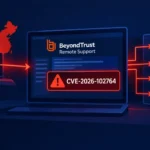
The campaign also included exploitation of a zero-day in BeyondTrust Remote Support (CVE-2026-102764, CVSS 9.3), which we have already covered. Through the Remote Support appliance, the attackers moved laterally into the internal infrastructure, escalated privileges to root and deployed additional tools.
Toolset
Google and Mandiant identified six malware families used in this campaign:
- SLIMSAVAGE and CAGEMATCH — JSP web shells for command execution and persistence on Linux devices
- BONESAW — CVE-2026-123890 exploitation utility
- SAWSNAKE — a Go-based utility for bypassing vCenter SAML authentication and generating session cookies, implementing a Golden SAML attack (a port of the open script vcenter_saml_login.py)
- BEARBONES — a C-based backdoor built on Dropbear SSH Server with credential interception
- LAZYBONES — a Go-based backdoor that uses Slack for command and control (C2), previously used in the exploitation of CVE-2025-22457 in Ivanti Connect Secure
The attackers scanned the internal network for ports 9080, 5480 and 2012 — the latter is the RPC interface for vCenter SSO and a key element of BONESAW’s exploitation chain.
Context: the second critical VMware Directory Service vulnerability in a year
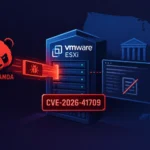
CVE-2026-123890 is the second critical authentication bypass vulnerability in VMware Directory Service in 2026. The first — CVE-2026-59309 (CVSS 9.8) — was fixed in July 2026 together with the directory traversal vulnerability CVE-2026-59310. We also previously wrote about the exploitation of the latter. In addition, CrowdStrike recently reported on Armory Castle’s use of the CVE-2026-41709 vulnerability in VMware ESX to reduce audit visibility.
Additional vulnerabilities in the advisory
In addition to CVE-2026-123890, advisory VMSA-2026-0009 addresses four less critical vulnerabilities:
- CVE-2026-123891 (CVSS 8.1) — SQL injection in SDDC Manager
- CVE-2026-123892 (CVSS 7.2) — command injection in SDDC Manager
- CVE-2026-123893 (CVSS 6.7) — privilege escalation to root in SDDC Manager
- CVE-2026-123894 (CVSS 6.7) — SAML token signature bypass in VMware Tools for Windows (requires configured Guest Alias mapping, remains within the guest VM)
All four require authenticated or already privileged access.
Recommendations
- Install updates immediately to versions 9.1.1.0200, 9.0.2.0200 or 8.0 U3m, depending on your branch. The updates are cumulative but do not support Quick Patch.
- Take the “Back-in-Time” limitation into account: installing 8.0 U3m or 9.0.2.0200 blocks subsequent upgrades to VCF 9.1.1. If you plan to migrate to VCF 9.1.1, first upgrade vCenter to 9.1.1 or wait for VCF 9.1.2.
- Plan for a short management outage: virtual machines continue running during the update, but management access and some encryption operations with Standard Key Provider are temporarily unavailable.
- Perform a retrospective compromise assessment: review network logs for connections to vCenter port 2012, the presence of unusual accounts in the vsphere.local domain, and SSH being enabled via the VAMI API.
- Check for indicators of compromise — files ActiveSer.jsp, u.jsp, /tmp/123, /tmp/sss, /tmp/dbr, /usr/bin/vmtoolscs, as well as network connections to IP addresses from the IOC list (103.147.251.5, 103.190.38.3, 185.71.15.109, 176.9.89.66 and others).
- For systems on vSphere 6.5, 6.7, 7.0 without extended support: accept that they are vulnerable and prioritize migration to supported versions.
According to Google, the use of two zero-day vulnerabilities and six specialized tools within a single campaign indicates the significant resources behind Armory Castle’s operations. Organizations using VMware vCenter should treat patch deployment as an emergency change — exactly in line with the vendor’s own classification — and simultaneously conduct a retrospective analysis for signs of prior compromise, especially if vCenter was accessible from network segments with internet connectivity.