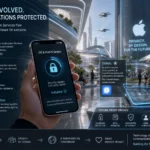
Apple has released a security update for iOS and iPadOS that closes a privacy‑impacting flaw in the Notification Services subsystem. The bug, tracked as CVE-2026-28950, allowed notifications marked as deleted to continue to be stored on the device, creating an unexpected source of recoverable message content for digital forensics.
What CVE-2026-28950 Changes in iOS Notification Services
According to Apple’s security bulletin, “notifications marked as deleted may remain on the device”. The issue lay in how iOS handled its internal push notification database — the system store used to deliver and display app notifications. Instead of fully erasing notification data, parts of the content could persist in system logs and service databases.
From a cybersecurity perspective, this is a classic logging and data retention vulnerability: information that users reasonably believe has been removed can still exist in internal storage. Apple reports that the issue has been fixed by improving data redaction and cleanup mechanisms, ensuring that superfluous or sensitive notification content is no longer retained after deletion.
How the iOS Notification Vulnerability Exposed Signal Messages
Public attention to CVE-2026-28950 increased after reporting by 404 Media, which described a U.S. FBI investigation where specialists were able to forensically recover incoming Signal messages from an iPhone even after the Signal app had been removed.
In that case, the content did not come from the app’s own storage. Instead, message fragments were recovered from the iOS system’s push notification database. When Signal messages arrived, the notification payloads containing text previews were logged by iOS. Deleting chats or uninstalling the app did not reliably erase all of those records before the patch.
This behavior undermines user expectations around end‑to‑end encryption. Even when an application such as Signal is designed so that message content is only readable on the endpoints, operating system–level logging can reintroduce exposure if notification payloads are stored too verbosely.
Why Push Notifications Are a Structural Privacy Risk
Push notifications often include more than just an app name. For convenience, many services embed the sender’s name, a snippet of the message, or even parts of attachments in the notification payload. As the Electronic Frontier Foundation (EFF) has repeatedly highlighted, there is no straightforward way for users to see exactly what metadata or content is present in each notification or whether it is encrypted end to end.
For privacy‑focused apps, this creates a secondary exposure channel: even if the main communication channel is strongly encrypted, the notification channel may leak sensitive information through system logs, lock‑screen previews, and cloud push services.
Risk Assessment: Who Is Affected and Under What Conditions
The iOS notification vulnerability does not enable remote compromise of a device. Instead, it amplifies the value of physical access combined with forensic tooling. Law enforcement agencies, incident responders, and private forensic companies can attempt to extract residual notification data from system stores when they have the device in hand.
For high‑risk users — journalists, political activists, lawyers, and executives handling confidential business information — even partial recovery of message snippets, sender identities, or timing information can be damaging. While it is not publicly known how widely this behavior was exploited before the fix, the incident demonstrates how system logs can quietly accumulate sensitive data over long periods.
How Apple and Signal Have Responded
Apple states that CVE-2026-28950 has been resolved by changing how Notification Services processes and cleans up stored data. In practice, this means that notifications marked as deleted should now be properly purged, and unnecessary content should no longer be retained in internal logs.
Signal has clarified that users do not need to perform any additional steps inside the messenger. The organization notes that once the relevant iOS or iPadOS update is installed, any accidentally stored notification data will be removed, and future notifications will not be retained for uninstalled applications. Signal’s team publicly acknowledged Apple’s quick response and emphasized the importance of privacy protections at the operating system level, not only within individual apps.
How to Protect Push Notification Privacy on iPhone and iPad
Hardening Signal Notification Settings
To reduce the amount of sensitive content visible in Signal notifications on iOS:
— Open your Signal profile → go to Notifications → find the Show option.
— Select “Name only” or “Neither name nor message”.
— These settings significantly limit what is displayed (and potentially stored) in notification banners and logs.
System‑Wide iOS Notification Hygiene
Beyond Signal, several system‑level practices can help strengthen privacy against notification‑based data leakage:
— Install iOS and iPadOS security updates promptly, especially those addressing vulnerabilities like CVE-2026-28950.
— Restrict notifications for non‑critical or untrusted apps: Settings → Notifications → disable unnecessary alerts and message previews on the Lock Screen.
— For sensitive messaging and email apps, use options such as “Hide notification content” or “Show only sender” to reduce exposed text.
— Treat push notifications as a potential side channel: the less content they reveal, the lower the risk of forensic recovery if someone gains physical access to your device.
The notification logging flaw in iOS illustrates a broader principle of digital security: strong encryption alone is not enough if interfaces, previews, and system logs quietly capture sensitive data. Maintaining privacy requires coordinated effort from operating system vendors, app developers, and users. Keeping devices updated, minimizing what appears in notifications, and applying basic digital hygiene remain essential steps for anyone who wants to protect both personal and professional communications on mobile devices.