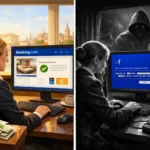
One of the world’s largest online travel platforms, Booking.com, has reported a cyber incident that resulted in unauthorized access to information about certain users’ reservations. As part of its response, the company has forcibly reset PIN codes for a number of current and past bookings and started emailing affected customers to notify them of the issue.
Official Booking.com statement on the cyber incident
Users began receiving mass notifications over the weekend from [email protected], a legitimate domain used by the company. The messages stated that a cybersecurity incident had allowed third parties to obtain access to personal information related to some reservations. Booking.com representatives later confirmed the incident in comments to technology outlet The Register.
According to the company, its security team detected “suspicious activity associated with unauthorized third parties gaining access to information about some guests’ bookings.” Following the discovery, Booking.com limited the attackers’ access, reset PINs for impacted reservations, and initiated direct notification of affected customers.
Booking.com claims that payment information was not compromised. This suggests that credit card numbers and payment transaction details should not be at risk. However, the exposure of detailed trip information still poses a significant security and privacy threat, particularly in the context of targeted phishing and social engineering attacks.
What reservation data may have been exposed
The company has not disclosed the full list of compromised data fields, the duration of the unauthorized access, the number of affected accounts, or the exact intrusion vector. It also remains unclear whether the incident stemmed from the compromise of partner hotel systems, third-party tools, or Booking.com’s internal infrastructure.
Typically, an online booking record contains at least: guest name and surname, contact email address, travel dates, hotel name and address, room type, number of travelers, and often a phone number and special requests. Even in the absence of full payment card data, this combination of personal and contextual information is highly valuable to cybercriminals.
Such data sets enable attackers to construct extremely convincing scams tied to real trips, bypassing many users’ initial skepticism and even some automated email security filters.
Why the Booking.com email alerts raised suspicion
One notable aspect of the incident is that notifications were sent only via email. Many users reported that they did not see any corresponding warning banner or alert inside the Booking.com app or website account interface. This mismatch led some recipients to doubt the authenticity of the emails, suspecting a new phishing campaign masquerading as an “official notification.”
The confusion was amplified by the fact that Booking.com, in the same messages, reiterates its standard advice: do not click suspicious links or share sensitive details in emails allegedly from hotels or the platform. Given the sharp global increase in phishing campaigns in recent years, this cautious reaction from users is justified and highlights the importance of multi-channel breach communication.
Security risks from exposed booking data
Highly targeted phishing using real travel details
Cybersecurity experts emphasize that context-rich phishing is far more effective than generic spam. An attacker who knows exact check-in dates, the hotel name, and the number of guests can craft emails that appear indistinguishable from legitimate operational messages.
On forums such as Reddit, some travelers are already reporting fraudulent emails and messages referencing specific reservation details. While a direct link to the current Booking.com incident has not been formally established, the pattern closely matches typical post-breach campaigns observed after other major data exposures.
Social engineering and impersonation of hotels or Booking.com support
Armed with accurate reservation information, criminals can convincingly impersonate hotel front desks or Booking.com support. Common pretexts include requests to “reconfirm card details,” pay an additional “tourist tax,” verify a “late check-in,” or “update your booking” via a malicious link.
According to the Verizon Data Breach Investigations Report 2023, the human element, including phishing and social engineering, is involved in the majority of breaches. Personalized messages with correct dates, names, and hotels significantly increase the likelihood that a target will click a malicious link or share sensitive information.
Security recommendations for Booking.com users
1. Treat all booking-related emails with caution. Instead of clicking links in emails, manually open the official Booking.com website or app, log in, and check for messages or changes in the “Trips” or “Bookings” section.
2. Never provide full card details via email or messenger. Legitimate hotels and Booking.com will not ask you to send complete credit card numbers and CVV/CVC codes through email, chat, or messaging apps. Make payments only through the official platform or verified payment gateways.
3. Enable two-factor authentication (2FA) wherever possible. A second login factor — such as an SMS code or authenticator app — significantly increases account security, even if a password is exposed in another breach.
4. Monitor your reservations and account activity. Regularly review your booking history for unfamiliar reservations, cancellations, or changes. At the first sign of suspicious activity, contact support directly via the official Booking.com site or app.
5. Use strong, unique passwords for travel services. Reusing passwords across platforms allows a compromise of one service to cascade into multiple account takeovers. A reputable password manager helps generate and store unique, complex credentials for every site.
Major incidents involving platforms like Booking.com underline a broader lesson: even if a company reacts quickly, users remain a critical line of defense. By strengthening basic “digital hygiene” — unique passwords, 2FA, independent verification of all payment requests, and a skeptical approach to any email asking for data — travelers can dramatically reduce the likelihood of falling victim to phishing, fraud, or identity theft, even when their booking information has been exposed.